OPERATION: MATTERHORN
OBJECTIVE 4,478 M WINDOW JUL–AUG 2027 ORIGIN DTW
EXPEDITION MATTERHORN · 2027
45°58′35″N 7°39′30″E · Monte Cervino · 4,478 m
OPERATION

Matterhorn

The most beautiful, most feared pyramid in the Alps. This is the real plan to stand on top of it — and I want you on the rope.

Objective
0 m
Grade
AD · III
Summit day
+0 m
The Brief

01 · The Objective

Why the Matterhorn,
and why next summer.

It's the mountain on the Toblerone. The one shape everyone on Earth recognises. Climbing it isn't a trek — it's a real alpine ascent of the Hörnli ridge, ~1,220 vertical metres of exposed rock and snow from hut to summit, roped up, moving fast, out before the afternoon turns on you.

And July–August is the window. Peak alpine season means the warmest, driest rock, the longest daylight for a big summit day, and the Hörnli Hut fully staffed at 3,260 m. It's the best odds this mountain gives you of a clean, safe summit — and the best light for the alpenglow that made it famous.

  • A real summit, not a viewpoint. You stand on the actual top — Italy on one side, Switzerland on the other.
  • Peak-season conditions. Dry rock, long days, huts open, guides working — the whole machine running.
  • Two ways to do it. Guided 1:1 with an IFMGA pro, or self-planned if we build the skills — you choose. Both are on the table.
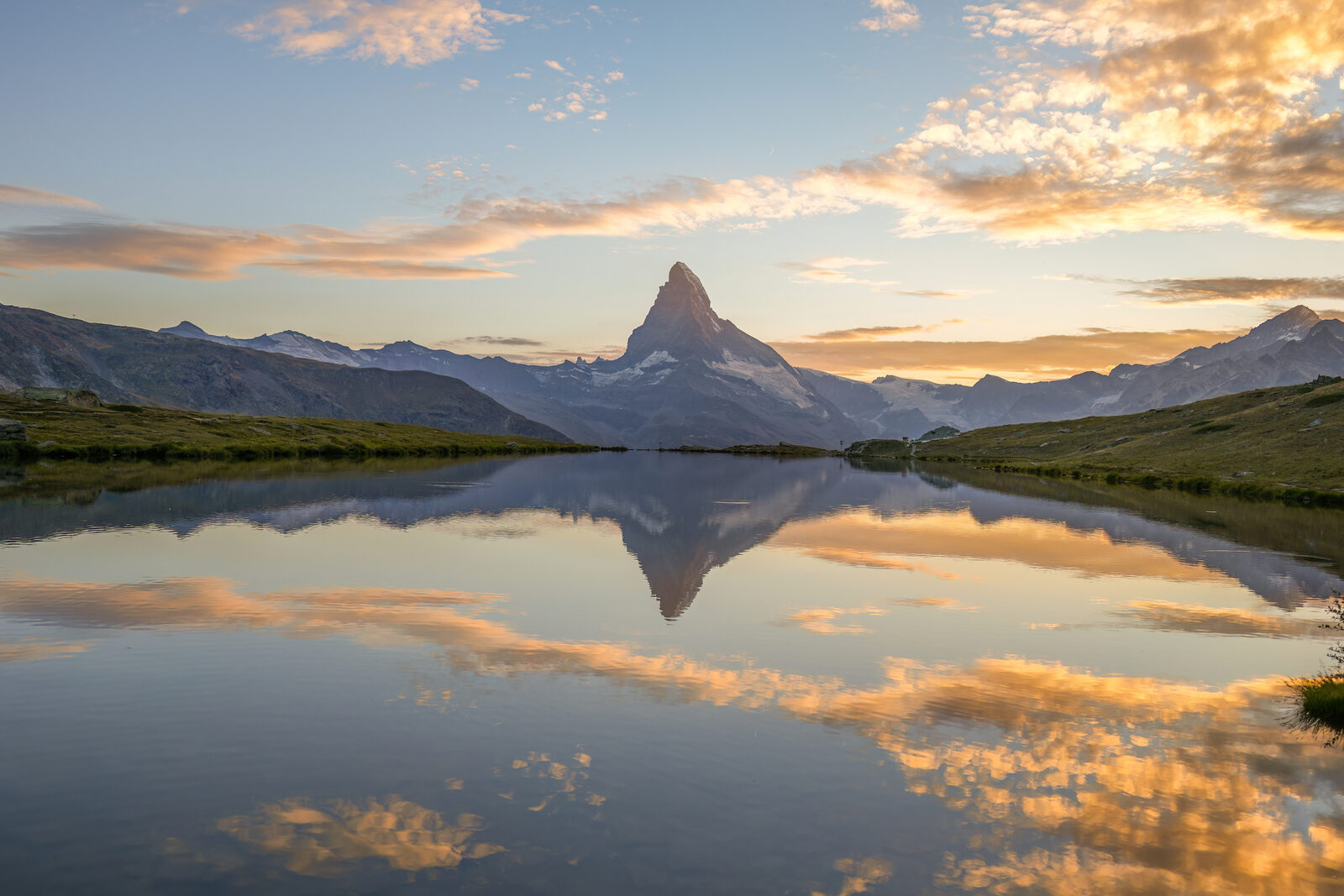
The Matterhorn glowing orange-pink at sunset, reflected in the Stellisee lake
Alpenglow on the Matterhorn, mirrored in the Stellisee — the payoff light
02 · The Approach · a week to get ready

The plan, day by day.

You don't just show up and climb the Matterhorn. We spend a week in Zermatt getting our bodies used to the altitude and our hands used to the rock — an acclimatization + skills build on nearby peaks, a rest day to wait out weather, then the move up to the hut and the summit bid. The line below is the daily high point we reach, climbing higher each day until the spike on summit morning.

▲ REST / WEATHER DAY  ·  ● SUMMIT BID  ·  PROFILE SHOWS THE HIGHEST POINT REACHED EACH DAY (WE SLEEP LOW IN ZERMATT UNTIL THE HUT)


03 · Summit Day

What the big day feels like.

One day decides the whole trip. Here's exactly how it goes — no sugarcoating, because this is the part you train for.

~04:00 — headlamps on

A start in the dark

You're up around 4am in the Hörnli Hut, choking down breakfast, roping up. First teams onto the ridge get clean rock and beat the crowds. You climb by headlamp into the cold, straight onto steep scrambling.

The climb

1,220 m of ridge

Sustained rock scrambling (UIAA II–III) with fixed ropes at the steep steps, past the tiny Solvay emergency hut at 4,003 m, then crampons on for the snow-and-ice crown near the top. Hands and feet the whole way. ~4–5 hours up if you're moving well.

The turn-around clock

Fast, or not at all

Guides run a hard checkpoint — reach the Solvay hut (4,003 m) within about 2½–3 hours of leaving, or you turn back, no debate. Pace only gets worse higher up. You have to be up and down before the afternoon brings rockfall and storms. Speed is safety here.

The summit

4,478 m, briefly

A narrow snow crest with a drop on every side. You get maybe fifteen minutes, a handful of photos, the whole Alps below you — and then the hard part starts, because you still have to get down.

The descent

Where it's won or lost

Down-climbing tired is the real crux — most accidents happen on the way down. Careful, roped, rappelling the steep bits, another ~5–6 hours back to the hut and on to Zermatt. A ~9–11 hour round trip, door to door.

Then: a beer in Zermatt

The best one of your life

Car-free streets, the mountain you just climbed framed at the end of them, and the specific, stupid grin of someone who was on top of that thing at sunrise. That's the photo. That's the whole point.

04 · The Team · two ways up

Guided, or on our own rope.

There's no law in Switzerland that says you need a guide for the Matterhorn — the Hörnli Hut takes independent climbers, and strong parties self-guide it every season. So we genuinely have two options, and the honest trade is safety and success-rate vs cost and self-reliance.

Guided · 1:1 IFMGA

the higher-odds way
≈ $7,700–9,000 pp

One IFMGA guide per climber on summit day — the local custom on this route, and it's what gets first-timers up safely. The guide finds the line, sets the pace, manages the rope, and makes the turn-around call.

  • Highest summit odds, biggest safety margin
  • No route-finding or rope decisions on you
  • Guide runs the prep climbs and assesses you first
  • Cost is dominated by the guide — it can't be shared

Self-guided · independent

the cheaper, harder way
≈ $3,700–5,100 pp

Legal and doable — but only if our team already has the alpine chops. Roughly half the cost, because there's no guide fee. The flip side: nobody finds the route for you, and nobody turns you around.

  • ~Half the price — no guide fee
  • Demands real skills: route-finding, moving together, grade III on crampons, whiteout nav
  • We carry all the risk and all the decisions
  • Only sane if we train seriously first

If we go guided — who takes us up

Real, hireable IFMGA outfits for the Hörnli ridge, from local Zermatt guides to all-inclusive packages. Prices gathered Sept 2026 — reconfirm the 2027 rate directly.

Every summit needs its own guide (1:1), so two of us climbing = two guides on the mountain. A guide will also run us up a prep climb first and can turn us back there if we're not ready — that's a feature, not a bug.


05 · Logistics · DTW → Zermatt

Detroit to a car-free village at 1,620 m.

No nonstop exists — we connect once through a European hub into Geneva or Zurich, then it's all trains. Fares are current-market estimates for peak summer (2027 seats aren't bookable yet); book ~10 months out.

AirlineViaIntoStopsEst. round-trip
Air FranceParis (CDG)GVA1$800–1,150
SWISS / LufthansaZurich / Frankfurt / MunichZRH / GVA1$850–1,200
Delta / KLMAmsterdamGVA / ZRH1$900–1,300
UnitedNewark + EU hubZRH1–2$850–1,300

The last leg is a train, not a taxi 🚂

Zermatt bans cars — you arrive by rail. From Geneva or Zurich airport it's the mainline to Visp, then the little red Matterhorn Gotthard Bahn cog railway up the valley to Zermatt: about 3½–4 hours total, roughly CHF 90–145 second class each way. If anyone drives, you park at Täsch and take the 12-minute shuttle in. Doing lots of side-trips? An 8-day Swiss Travel Pass (~CHF 439) can be worth it — otherwise point-to-point tickets win.

06 · The Budget · pick your mode, drag the slider

What it actually costs.

Everything, door to door from Detroit — flights, the train, the Zermatt week, huts, lifts, gear, rescue insurance, buffer. Switch between guided and self-guided, then drag the slider for group size. Fair warning: in guided mode the 1:1 guide is the biggest line and can't be split, so more friends only shares the apartment — the number barely moves. That's the honest math.

Per person · all in
$0
group total · $0
Rope team size 4 climbers
23456

The breakdown

PER PERSON, GUIDED, AT 4 CLIMBERS · USD
Per person$0

Estimate, not a quote — built from Sept 2026 research (sources in the footer). Swiss costs converted at ~1.15 USD/CHF. The guide fee is the single biggest variable; international airfare is next. Excludes trip-cancellation insurance and personal splurges.


07 · The Kit

What to bring — and what to rent in Zermatt.

This is technical alpine gear, not hiking kit. Bring what has to fit your body; rent the hardware in Zermatt, where the shops are stocked for exactly this climb.

Bring from home

  • Mountaineering boots (crampon-rated B2/B3) ESSENTIAL
  • Broken-in — blisters end summits ESSENTIAL
  • Base + mid layers, softshell ESSENTIAL
  • Hardshell jacket + gloves ×2 ESSENTIAL
  • Headlamp + spare batteries ESSENTIAL
  • Glacier sunglasses + sunscreen ESSENTIAL
  • Personal first-aid + any meds PERSONAL
  • Small pack (30–35 L) SMART

Rent / sort in Zermatt

  • Crampons RENT
  • Ice axe RENT
  • Harness RENT
  • Helmet RENT
  • Via-ferrata / climbing kit RENT
  • Rope + rack GUIDE / SELF-TEAM
  • Hörnli Hut bed + half-board BOOK AHEAD
  • Sleeping-bag liner ~CHF 43

Guided, your guide coordinates the technical hardware and the rope. Self-guided, the team brings its own rope, rack and glacier kit. Budget ~CHF 150–250 pp to rent the gaps for the week — it's in the calculator.

08 · Risk Assessment · straight talk

The honest dangers.

The Matterhorn is one of the deadliest peaks in the Alps — an estimated 500–600 people have died on it since the first ascent in 1865, and typically 6–12 a year. For honesty's sake, the flip side: thousands climb it each summer, so a single careful, well-prepared ascent runs a far lower risk (on the order of 0.1–0.4%). A good pitch says all of it out loud — and says how we cut each risk down.

Rockfall & the clock

The ridge sheds rock, worse as the day warms and as more parties climb above you. We beat it with an alpine start, a fast pace, helmets on the whole time, and a hard turn-around — up and down before the mountain wakes up.

Falls — especially descending

It's sustained, exposed grade II–III where a slip has consequences, and most accidents happen on the tired down-climb. We stay roped, rappel the steep steps, and train the movement until it's automatic before we ever leave the hut.

Fitness & the turn-around

This is the real filter: ~1,220 m up in 4–5 hours at altitude, then back down — a 9–11 hour day. We train for months and prove it on prep climbs (Breithorn, Pollux). If someone isn't moving fast enough, the summit waits for another year.

Weather windows

The Matterhorn only goes in good weather — wet or iced rock shuts it down, and storms are lethal up high. That's why the plan has rest and buffer days built in, and why we may sit out a day to catch a clean window. Many trips don't summit; that's the deal.

Altitude

At 4,478 m the air is thin. The whole first week — Gornergrat, Breithorn, Pollux — exists to acclimatize us gradually so summit morning isn't the first time our bodies feel the height. Anyone struggling goes down; ego doesn't summit.

Self-guided = no safety net

Legal isn't the same as safe. Without a guide there's no professional reading the conditions, finding the line in cloud, or making the hard turn-around call — that judgment is exactly what keeps people alive here. We only go independent if we're genuinely ready, and we carry Air Zermatt / Rega rescue + repatriation cover either way.
09 · The Call

Are you on the rope?

This only happens if a few of us commit and start training now. Here's all I need to lock it in.

STEP 01Say you're inText me a yes. I need a real headcount to price it and decide guided vs self-guided as a group.
STEP 02Start trainingWe build cardio and get on real rock this winter. The mountain is won in the months before, not on summit day.
STEP 03We book the windowGuides and Hörnli Hut beds for summer 2027 open around April 2027 — we grab dates together and it's on.
Commit by Feb 2027 to lock guides & fares · Hut beds open ~Apr 2027 · Summit window Jul–Aug 2027